Introduction
In an age where smartphones guide us through traffic and artificial intelligence helps decode complex medical data, the operating room is also undergoing a quiet revolution — telesurgery.
For paediatric surgeons and urologists, telesurgery offers something far more profound than convenience: the promise of access, accuracy, and equity. It allows expert surgeons to operate on children remotely, in real time, using robotic systems — bridging the gap between location and life-saving intervention.
What is Telesurgery?
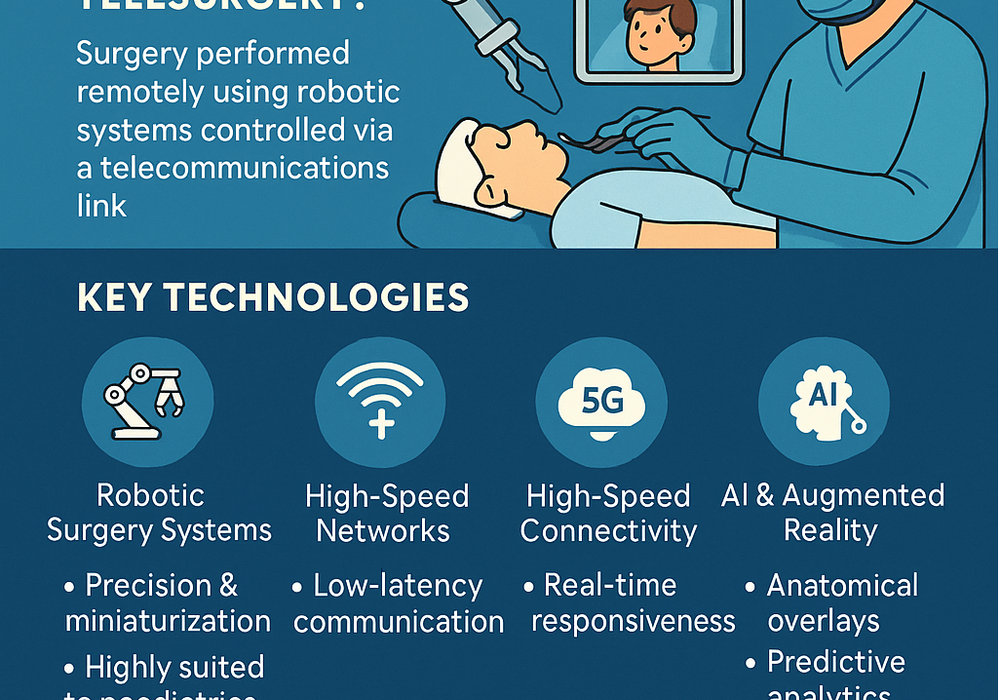
Telesurgery, or remote surgery, refers to performing surgical procedures where the surgeon is not physically present at the patient’s location, but instead controls robotic instruments via a secure telecommunications link.
It’s powered by a combination of:
- Surgical robotics (like the da Vinci system)
- High-speed internet / 5G networks
- Advanced haptic and visual feedback systems
- AI-powered analytics and diagnostics
This is especially valuable in paediatric urology and surgery, where precision, miniature anatomical scale, and reduced surgical trauma are critical.
Why Telesurgery in Paediatrics Makes Sense
1 Specialist Shortage in Remote Areas
- India has fewer than 1 paediatric surgeon per 200,000 children in rural regions.
- Telesurgery allows tertiary centres to support peripheral hospitals during emergencies or elective surgeries.
2 Complex Congenital Conditions
- Conditions like posterior urethral valves, hypospadias, or Hirschsprung’s disease often require expertise not available outside major metros.
- Telesurgery provides real-time mentoring or actual remote intervention by specialists.
3 Minimal Access Surgery, Maximally Delivered
- Paediatric MIS (laparoscopy, retroperitoneoscopy, robotic-assisted) is technically demanding.
- With robotic precision and telesurgical guidance, the learning curve can be flattened for young trainees under real-time supervision.
Key Technologies Behind Telesurgery
Robotic Surgery Systems
- Da Vinci Surgical System: Allows for high-definition 3D visualization and fine-tuned wristed instruments, ideal for small anatomy in children.
- Emerging platforms are now being customized for paediatric needs with smaller arms and ports.
High-Speed Connectivity
- 5G networks and ultra-low latency enable real-time responsiveness — critical for precision.
- Pilot studies from China and South Korea have shown telesurgical latency as low as 150 milliseconds, well within acceptable thresholds.
AI & Augmented Reality
- AI overlays can guide dissection planes, mark critical anatomy, or even predict complications.
- AR can help display anatomical maps on the surgical console in real-time — particularly useful in congenital anomalies.
Real-World Applications in Paediatric Surgery
Global Examples:
- China (2019): A 5G-based telesurgery system allowed a neurosurgeon to operate on a patient 3,000 km away.
- India (AIIMS): Pilot projects are exploring hybrid models combining tele-mentoring + robotic interface for congenital procedures.
Use Cases in Paediatric Urology:
- Remote-assisted pyeloplasty in obstructive hydronephrosis.
- Posterior urethral valve fulguration guided by experts remotely in real-time.
- Bladder exstrophy repair mentoring, allowing novice surgeons to be assisted by specialists during reconstruction.
Benefits of Telesurgery in Paediatrics
Equitable access to advanced care in tier-2 or rural hospitals Reduced travel burden on fragile neonates and families Improved training opportunities for junior surgeons Minimized errors via real-time expert guidance Scalable healthcare models without building new mega-centres
Challenges & Ethical Considerations
Latency & Connectivity GapsEven milliseconds matter in surgery — the tech must be reliable 100% of the time.
Data SecurityEncrypted transmission of patient data and robot commands is non-negotiable.
Legal ResponsibilityIn a multi-site, multi-location scenario — who is liable if complications arise?
Cost of TechnologyInitial setup and robotic platforms remain expensive, though expected to drop with wider adoption.
The Way Forward: A Hybrid Future
The future isn’t entirely robotic or entirely remote. Instead, the model evolving looks like:
- Remote mentoring via AR/VR for high-volume neonatal surgeries
- Robotic-assisted telesurgery for rare and complex cases
- Simulation-based training platforms for paediatric surgeons-in-training
- Mobile surgical vans linked to tertiary telesurgical hubs
Conclusion
In the hands of a skilled paediatric surgeon, technology becomes a scalpel, not a screen. Telesurgery is not about replacing the surgeon — it’s about extending their reach, ensuring every child, regardless of postcode, has access to the best hands in paediatric care.
From fragile newborns in NICUs to adolescent boys with complex urological anomalies, the impact of telesurgery is transformative.
Let’s Talk
Do you see telesurgery becoming the norm in paediatric practice in India?Have you mentored or been mentored remotely in surgery?
Share your thoughts and experiences in the comments. Repost if you believe every child deserves access to surgical excellence, no matter where they live.