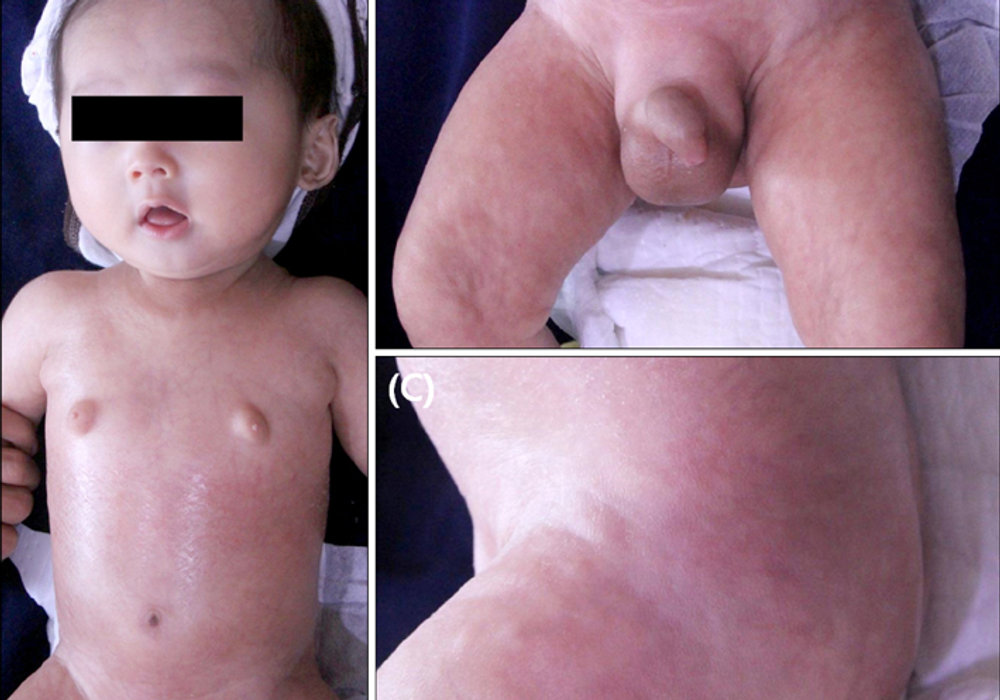
Prune belly syndrome, also known as Eagle-Barrett syndrome, is a rare congenital disorder characterized by a triad of abnormalities:
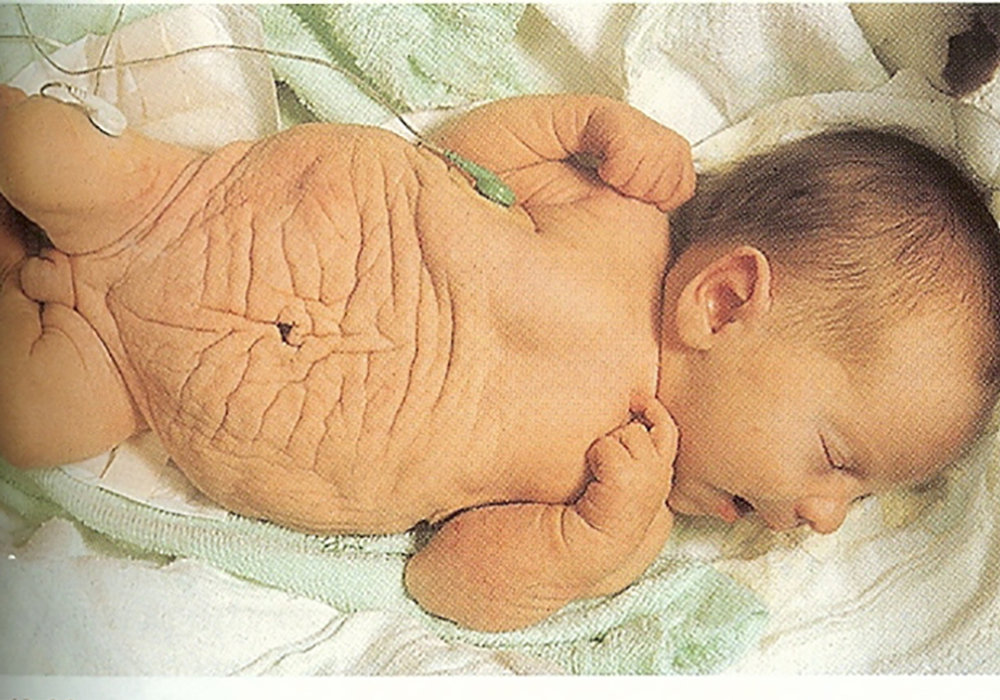
- Absent or underdeveloped abdominal muscles: This results in a thin, wrinkled abdominal wall, giving it a "prune-like" appearance.
- Urinary tract abnormalities: These can include enlarged ureters (tubes that carry urine from the kidneys to the bladder), bladder wall weakness, and urinary tract obstruction.
- Cryptorchidism: Undescended testicles are common in boys with prune belly syndrome.
Synonyms:
- Abdominal Muscle Deficiency Syndrome
- Congenital Absence of the Abdominal Muscles
- Deficiency of abdominal musculature
- Eagle-Barrett Syndrome
- Obrinsky Syndrome
- Triad syndrome
Causes:
The exact cause of prune belly syndrome is unknown, but it is believed to be due to a combination of genetic and environmental factors.
-It may be caused by an abnormality in the bladder during fetal development. Accumulation of urine can distend the bladder, the ureters, and the kidney. As the bladder enlarges, it causes wasting (atrophy) of the abdominal muscles. Retention of the testes in the abdomen (cryptorchidism) may be attributed to obstruction by an unusually large bladder or to obliteration of the groin (inguinal) canals. By the time of birth, the obstruction at the bladder outlet or the urethral obstruction may have been resolved, so that no mechanical obstacle can be identified after birth.
-Other researchers consider the urinary abnormalities as secondary to the incomplete development of abdominal muscles. Incomplete emptying of the bladder leading to urinary retention and infection can occur as a result. Constipation and symptoms of indigestion are additional possible complications. Since the abdominal muscles are important for respiration, deformity of the chest could be explained by their absence.
-A third possibility is that the muscle deficiency and the urinary abnormalities have a common cause that has not yet been discovered. A nervous system defect that could be responsible for early malfunction of abdominal muscles may be the cause. Association with a congenital open spinal canal (spina bifida) has been identified in some children, and the presence of clubfeet is also fairly commonly associated with Prune Belly syndrome.
Affected populations:
Prune Belly syndrome is a very rare disorder that is present at birth. The disorder affects mostly males but a few female cases have been described in the medical literature.
Clinical Presentation:
- Distended abdomen: The most striking feature, often noticeable at birth.
- Urinary tract infections: Frequent and recurrent urinary tract infections are common.
- Difficulty urinating: Weak urine stream or difficulty initiating urination.
- Hydronephrosis: Enlargement of the kidneys due to obstruction of urine flow.
- Respiratory complications: Weak abdominal muscles can affect breathing.
Diagnosis:
The diagnosis is usually obvious from birth, but various imaging tests are required to determine the location and number of abnormalities, that are present.
A full understanding of the complications will involve imaging tests such as ultrasound, X-ray, and, in order to determine the extent of involvement of the genitourinary tract, intravenous pyelogram (IVP), that makes use of a dye to map the degree of involvement of the kidneys and their ducts.
Management:
- Urinary tract management: This is crucial and may involve:
- Medications: To treat urinary tract infections and improve urine flow.
- Surgical procedures: To correct urinary tract obstructions and improve bladder function : Treatment will depend upon the severity of the symptoms. Some children will require rather modest surgical procedures such as the creation of a small opening in the bladder through the abdomen (vesicostomy) that will facilitate voiding of urine, or a procedure to help the testicles descend into the scrotum (orchiopexy). More extensive surgical procedures such a. bladder reconstruction (cystoplasty), surgical widening of the urethra, and augmentation of the muscles that contract the bladder (detrusor augmentation) using a paired graft of a hip muscle (rectus femoris) have been successfully undertaken on children with prune belly syndrome. In rare cases, kidney transplantation may be necessary.
- Respiratory support: In some cases, respiratory support may be necessary.
- Physical therapy: To strengthen abdominal muscles and improve physical function.
Prognosis:
Prune belly syndrome can have a significant impact on a child's quality of life. However, with early diagnosis and comprehensive management, including a multidisciplinary approach involving urologists, nephrologists, and other specialists, many children with prune belly syndrome can lead relatively normal lives.
Conclusion:
Prune belly syndrome is a rare but complex congenital disorder that requires specialized care. Early diagnosis and a multidisciplinary approach to management are crucial for optimizing outcomes for these children.
References
TEXTBOOKS
- Beers MH, Berkow R., eds. The Merck Manual, 17th ed. Whitehouse Station, NJ: Merck Research Laboratories; 1999:2222.
- Berkow R., ed. The Merck Manual-Home Edition.2nd ed. Whitehouse Station, NJ: Merck Research Laboratories; 2003:1512.
- Behrman RE, Kliegman RM, Arvin AM., eds. Nelson Textbook of Pediatrics. 15th ed. W.B. Saunder Company. Philadelphia, PA; 1996:1539-40.
REVIEW ARTICLES
- Strand WR. Initial management of complex pediatric disorders: prune belly syndrome, posterior urethral valves. Urol Clin North Am. 2004;31:399-415.
- Summaria V, Minordi LM, Canade A, et al. Megaureter and ureteral valves. Rays. 2002;27:89-91.
- Cromie WJ. Implications of antenatal ultrasound screening in the incidenece of major genitourinary malformations. Semin Pediatr Surg. 2001;10:204-11.
- Woolf AS, Thiruchelvam N. Congenital obstructive uropathy: its origin and contribution to end-stage-renal disease in children. Adv Ren Replace Ther. 2001;8:157-63.
- Jennings RW. Prune belly syndrome. Semin Pediatr Surg. 2000;9:115-20.
JOURNAL ARTICLES
- Fusaro F, Zanon GF, Ferreli AM, et al. Renal transplantation in prune-belly syndrome. Transpl Int. 2004;17:549-52.
- Sinico M, Touboul C, Haddad B, et al. Giant omphalocele and “prune belly” sequence as cmponents of the Beckwith-Wiedemann syndrome. Am J Med Genet A. 2004;129:198-200.
- Chan YC, Bird LM. Vertically transmitted hypoplasia of the abdominal wall musculature. Clin Dysmorphol. 2004;13:7-10.
- Salihu HM, Tchuinguem G, Aliyu MH et al. Prune belly syndrome and associated malform-ations. A 13-year experience from a developing country. West Indian Med J. 2003;52:281-84.
- Patil KK, Duffy PG, Woodhouse CR, et al. Long-term outcome of Fowler-Stephens orchiopexy in boys with prune-belly syndrome. J Urol. 2004;171:1666-69.
- Al Harbi NN. Prune belly anomalies in a girl with Down syndrome. Pediatr Nephrol. 2003;18:1191-92.
- Wisanuyotin S, Dell KM, Vogt BA, et al. Complications of peritoneal dialysis in children with Eagle-Barrett syndrome. Pediatr Nephrol. 2003;18:159-63.
FROM THE INTERNET
- Krauss C. Medical Encyclopedia: Prune belly syndrome. MedlinePlus. Update Date: 11/3/2003. 2pp.
- Franco I. Prune Belly Syndrome. emedicine. Last Updated: August 24, 2001. 13pp.
- About Prune Belly. Prune Belly Syndrome Network. Page updated 07/24/2004. 5pp.
- ‘Prune belly’ syndrome. Orphanet. Update: 17/04/2005. 1p.
- Prune Belly Network. Contact a family. Last approved July 2004. 3pp.
- Prune Belly Syndrome. Genitourinary and Kidney Disorders. University of Utah Health Sciences Center. ©2003. 3pp.
- Brooks DG. Prune belly syndrome. University of Maryland Medical Center. ©2004 A.D.A.M. various.
Disclaimer: This information is for general knowledge and educational purposes only and does not constitute medical advice. Always consult with a qualified healthcare professional for diagnosis and treatment.